Jeff Van Gundy has never shied away from new rule proposals. As a prominent voice of the NBA, this is good for potential progress, if not for laughs. During last night’s broadcast of the NBA Finals, Van Gundy suggested two new rules. One, if you make a three-pointer with only one shoe on, it should be worth four points. The other rule, offered in earnest, is that corner threes should not equal the value of a three on the arc.
The corner three is slightly closer than an arc three: 22 feet from the basket vs 23.9 feet. That difference helps players shoot a much higher percentage. In the 2014-2015 season, teams shot 38.7% from the corner and 35% from other threes.
To differentiate the point value of these shots, the league would logically need to establish a new point gradation inside the arc as well: for in this mindset, surely a dunk is worth less than a 21 foot jump shot. So let’s color new court lines and zone out a Four Point Distribution.
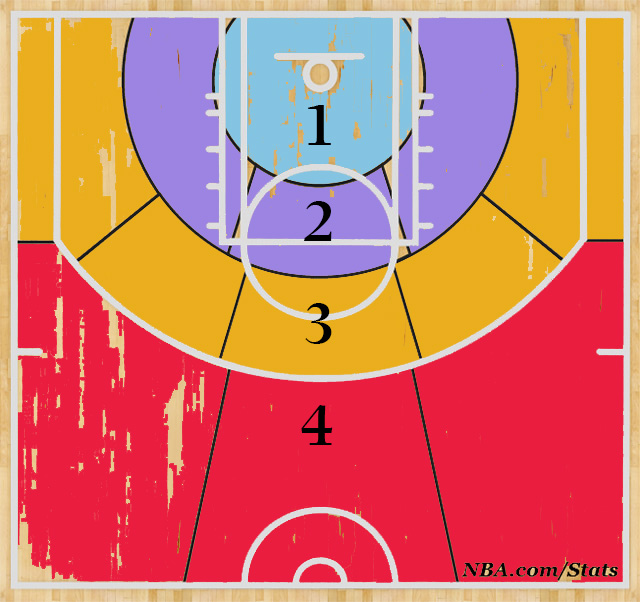
In this model, layups are worth one point, as are free throws. There’s a two point zone and a three point zone that includes the corner three. Four points are awarded behind the arc, without or without both shoes on.
You may be wondering: how would Four Point Distribution affect the scoring of last night’s game? Let’s first look at the visiting Cleveland Cavaliers.
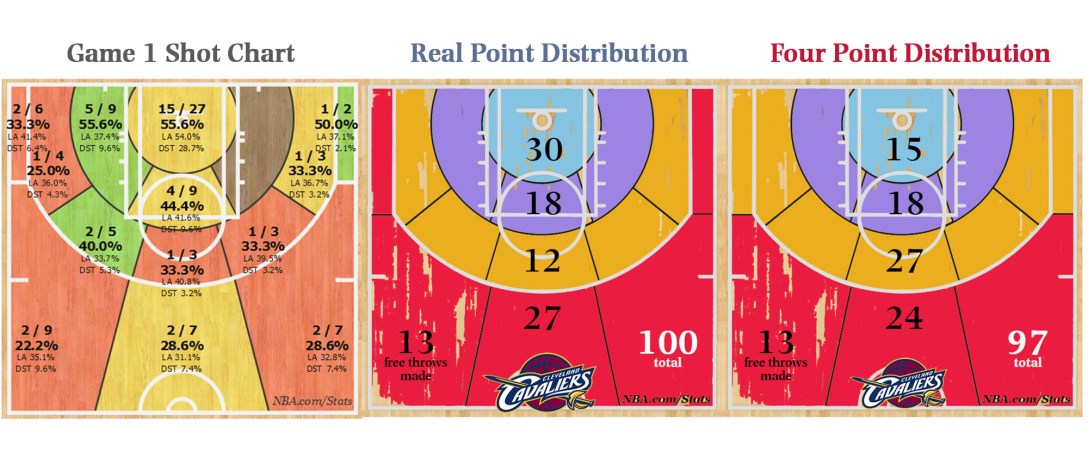
LeBron James and the Cavs did most of their damage in the restricted area, scoring 38% of their buckets at the rim. That hurts you in this new model. Also a third of its threes came from the corner, which cuts down on the number of four pointers you might expect. Onto the Warriors.
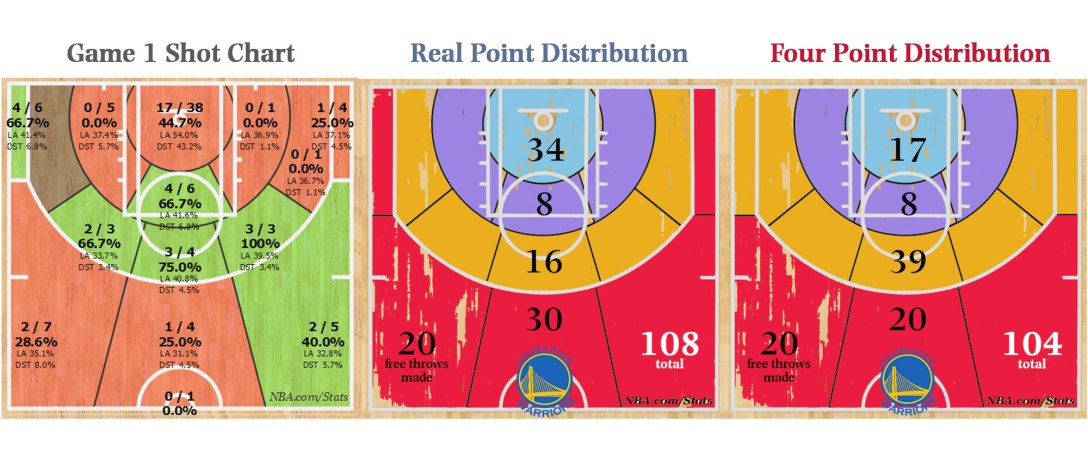
Last night, the Warriors hit the same number of corner threes (5) as non-corner threes. As you can see, that nets a huge positive in mid-range three-pointers but a drop in four-point baskets. The Warriors were also monsters at the rim, a big no-no.
Overall both teams scored roughly the same amount of points in either point distribution model. Regular season averages were a different story.
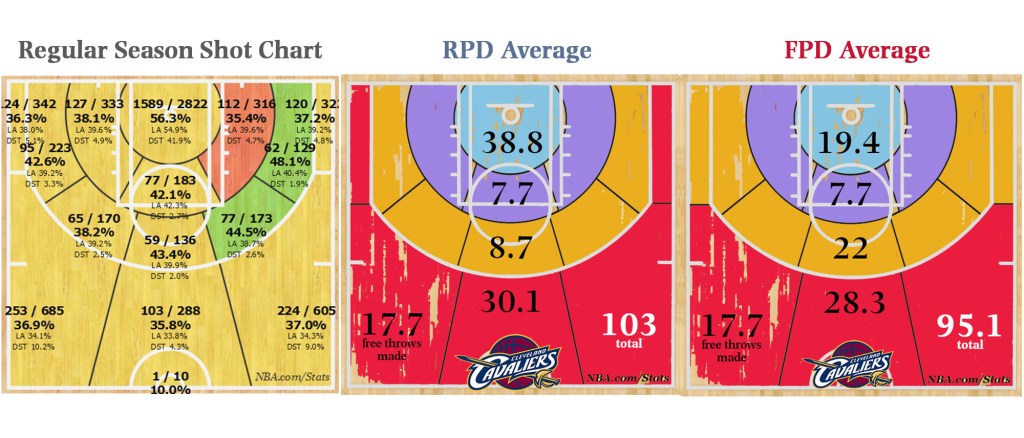
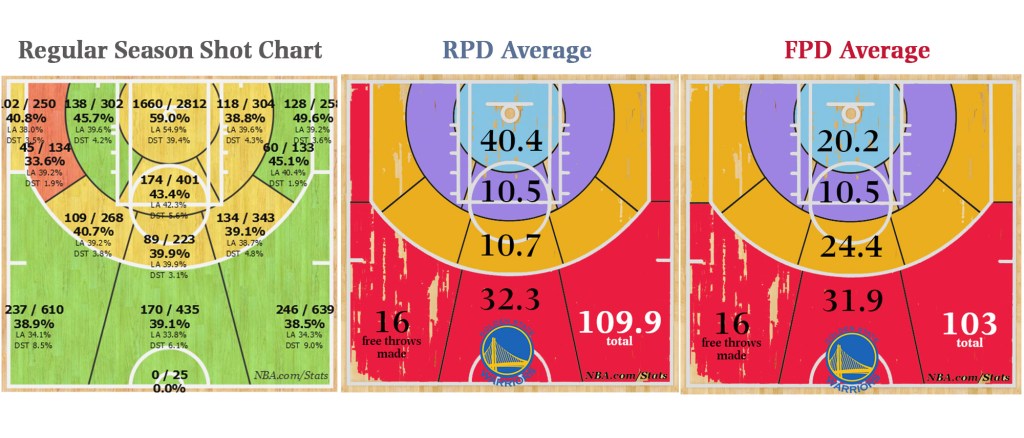
The season averages showed a wider discrepancy. The red zones, factoring in the loss of corner threes and the additional point per remaining shot, totaled roughly the same averages. The loss for both teams was the delta of one-point layups and three-point mid-range jumpers.
For good reason, today’s NBA shies away from the midrange game. Smart teams aim to only take layups and three-points. It’s a decent question, however, if that’s best for basketball. Should a shot just inside the three-point line be frowned upon? Should any open shot be deemed a bad shot?
The new model in practice wouldn’t fix this problem, but instead make layups a “bad shot.” Defenses would waive ball handlers into the paint for free shots, in an effort to more quickly get a chance for a four point play. The Warriors are making 39% of their long threes and 59% at the rim. If a team only took four pointers and another only took one-pointers, 90 shots each at those percentages would equal a score of 140-53. Even if the one-point area is equal to two, that score is still 140-106. Given that advantage, a four point shot would be great for an All-Star game, but that’s about it.
 GatheringWool